
The Collecting Journey – Built to Last: The Shogren-Meyer Collection of American Art
- Martha Bordwell
- Apr 30
- 3 min read
On April 2, a small group gathered in the Cargill Gallery for a conversation with Dan Shogren and Susan Meyer, who for twenty-five years have been amassing a collection of paintings and photographs which explore industrial art from the late 1920s to the early 1940s. Holdings from their collection comprise the exhibit, “Built to Last: The Shogren-Meyer Collection of American Art,” on view in Cargill through June 14, 2026. Spencer Wigmore, the curator of the exhibit, led the discussion.

Graveyard, Houses, and Steel Mills, Bethelhem, Pennsylvania, 1935 • Walker Evans (American)
Gelatin silver print
The Shogren-Meyer Collection
Spencer began by asking Dan and Susan why they chose to focus on works depicting industry during this period. Susan replied that she had always been interested in the depression era because of its impact on her parents. In addition, both Dan and Susan have a background in history and have worked in industry, so that made this subject a good fit.
The couple started small, collecting works with Minnesota connections and primarily purchasing prints. Later they expanded. They didn’t try to buy works by artists with “big” names, but rather took pleasure in raising the profile of artists who never achieved much notice.
One of the fascinating aspects of this conversation was the couple’s reference to specific artworks and artists to illuminate their process. Throughout their collecting journey, Shogren and Meyer have particularly enjoyed researching individual artists. One artist they learned about was Jack Keijo Steele who, according to Spencer, painted one of the most popular works in the show, “The Sweeper.” Steele studied at the Cranbrook Academy of Art in Michigan but spent his career at Ford Motor Company in Detroit. He was discovered by a dealer who learned about him from Steele’s nephew. When the dealer visited Steele’s home, he was shown a vast array of paintings languishing in an attic. Steele had never sold a single work. The dealer was so impressed with his work that he suggested having a show. At the show, half the paintings sold. Steele died shortly afterward, apparently thrilled to have his life’s work appreciated. (Interesting aside: the frame for the painting was made by Steele himself, a necessity for many artists with limited means).
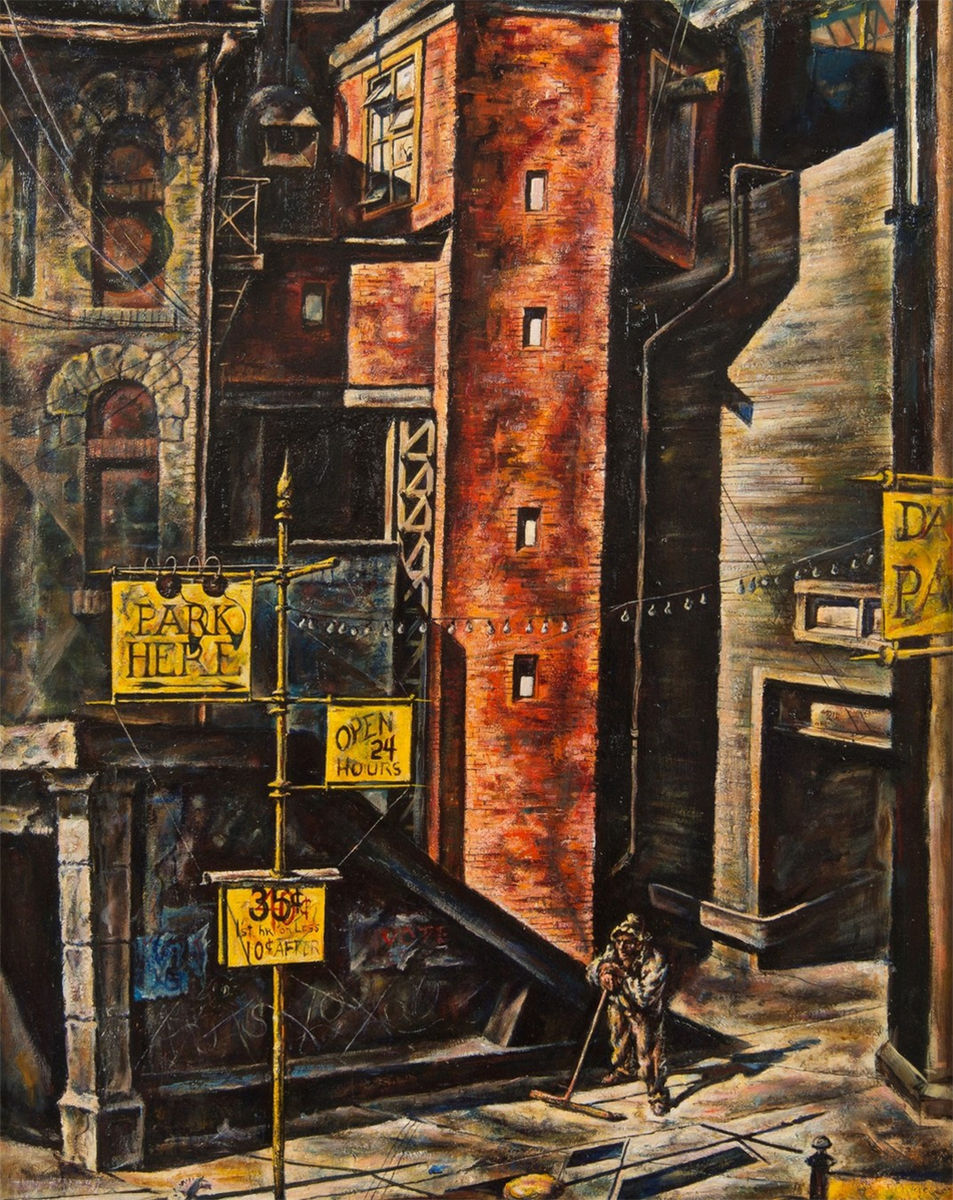
The Sweeper, 1940 • Jack Keijo Steele
Oil on canvas
Spencer asked the couple how they decide what to buy and what not to buy. Both were emphatic. Buy what you like. But they also try to achieve variety in their collection. They sometimes bid at auctions or purchase from galleries. Of course, cost is a factor. But Susan quoted a friend. “ The only purchases you regret are the ones you didn’t make.”
Is collecting photography different than collecting paintings? Dan said that it’s simply the same subject with two different artforms. He drew our attention to the similarities in composition and message between Harry Gottleib’s painting “Industrial Landscape” and Walker Evans photograph “Graveyards, Houses, and Steel Mills, Bethlehem, Pennsylvania.” The couple value showing their collection in ways that create a dialog between painting and photography, as they view these mediums as interconnected and part of a larger whole.

Industrial Landscape, 1937 • Harry Gottlieb
Color screenprint on paper Smithsonian American Art Museum, Museum Purchase • 1980.17.2
Spencer said that one of the privileges of being a curator is the opportunity to form relationships with collectors and to exchange information as both the collector and curator seek to develop their artistic holdings. They can serve as eyes and ears for one another.
Finally, the couple was asked what they wish the legacy of their collection to be. Susan said she is proud to have raised the profile of artists who didn’t achieve appreciation during their lifetimes. Dan added that he hopes the collection resonates with issues society is facing presently, such as the conflict between industrialization and protection of the environment, defunding of the arts, and activism and protest.
My thanks to Elisabeth Johnson Holod and especially Spencer Wigmore for their help with this article.


Thank you for this article, Martha. It was a privilege to meet and hear the collectors' stories about their acquisitional learning curve. As curator, Spencer's insight lent a rich background for the questions and answers. Bonus point was having Spencer's father present to provide a bit of backgroud on the curator as well! I found this to be a very enriching experience.