
On The Road with FRIENDS: Milwaukee
- Maryam Marne Zafar and Lyn Osgood
- Nov 7, 2025
- 5 min read
We came. We saw. We thoroughly enjoyed! The first Art & Architecture FRIENDS trip created by Lisa Mayotte, Lyn Osgood and Marne Zafar had FRIENDS, both new and familiar, coming together to explore Milwaukee.
Discover Milwaukee. That’s what the FRIENDS were determined to do. We found that this is truly a city worth visiting. The arts are vibrant. The architecture is noteworthy.
A walkable city, it allows its visitors to tour neighborhoods where the past is clearly present with museums that enlighten with their impressive contemporary collections.
So where did we start?
One would think we would fly into Milwaukee. But no – the decision was made to be carbon neutral friendly and travel by train! This translates to being comfortable and relaxed with a lunch to enjoy and great conversation, all while watching the scenery as we sped through the countryside of Minnesota and Wisconsin via the Amtrak Borealis.

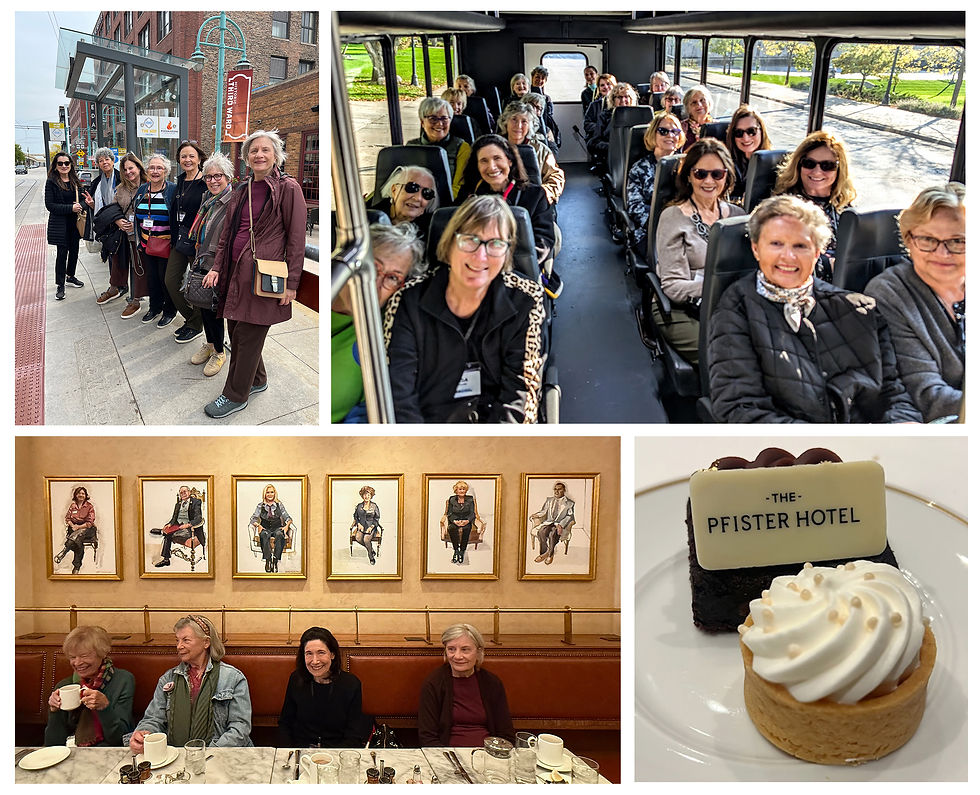
And where did we make our “home away from home” – The Pfister Hotel.
The Pfister
One of the U.S.’s top ten historic hotels and over 130 years old, The Pfister was ideal for those of us who want to surround ourselves with art. Its Romanesque Revival style which blends Victorian-inspired and Art Nouveau elements translates into luxurious, ornate details; as well it also houses the largest Victorian art collection anywhere.
What keeps this hotel thoroughly in the here-and-now? It celebrates contemporary art through its Artist in-Residence yearly program for a local artist to connect with a guest community and with its hallways filled with art from throughout the country.

Photo Credit: April Netley, top row; Marne, bottom row.
After a refreshing evening where all FRIENDS enjoyed a welcome dinner, the next morning saw us walking (yes, only a 7-minute walk) to our first stop …
Milwaukee Art Museum
As one of the Midwest’s premier art museums, MAM (as the Milwaukee Art Museum is affectionately called) does not disappoint! This museum is an architectural landmark, designed by three legendary architects: Eero Saarinen, David Kahler and Santiago Calatrava. In 2001, the visionary Calatrava designed the cathedral-like Quadracci Pavilion with vaulted 90-foot ceilings; with the pedestrian suspension Reiman Bridge connecting the museum to the city ... and its incredibly impressive Burke Brise Soleil – its “wings” – that unfold and fold twice a day. Breathtaking!!
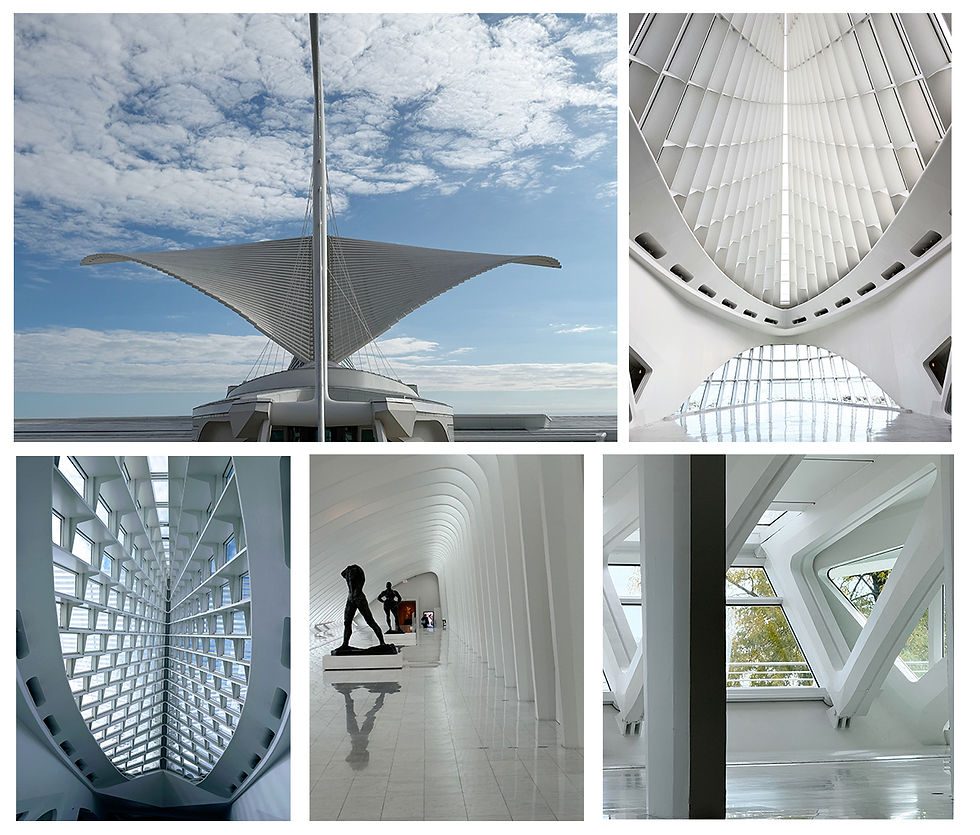
Photo Credit: Marne Zafar, upper left. Lower middle and lower right. April Netley, upper right and lower left.
As eye-opening as the wings were, the FRIENDS were there to see The Bradley
Collection of Modern Art: A Bold Vision for Milwaukee. Donated fifty years ago by
Mrs. Harry Lynde “Peg” Bradley, her extraordinary collection comprises over 400 twentieth-century masterpieces that have shaped the museum’s overall collection.
This exhibition showcased nearly 100 works by many of that century’s greats such
as the United States’ Georgia O’Keeffe, Mark Rothko, Helen Frankenthaler, Morris
Louis, Richard Diebenkorn and Europe’s finest such as Maurice de Vlaminck, Barbara Hepworth, Gabriele Münter and Wassily Kandisky. Whew! We were
spellbound by the art seen and also, by the lecture tour given by the Senior Curator
of Contemporary Art, Margaret Andera. Our visit was made even more memorable
by the attention to detail by Amy Kirschke, MAM’s Barbara Brown Lee Chief Learning
& Engagement Officer.

Photo Credit: Lisa Mayotte, April Netley and Marne Zafar
After a short lunch at MAM, we were picked up by our bus which took us to our next stop –The Burnham Block Homes designed by Frank Lloyd Wright …
Frank Lloyd Wright's Burnham Block
As one who studied architecture at Cornell University, Frank Lloyd Wright is legendary for many reasons. What we and many others were not aware of was this beautiful street lined with homes he designed for the working-class, low-income family. These “American System-Built” homes were to be efficient, economical and be life-enhancing works of art. Wright asserted that his homes would save material waste and be erected for a fraction of the cost as they were pre-cut lumber with materials to assemble made at a factory. He produced over 900 working drawings. Truly small masterpieces - each are only about 800 square feet and seamlessly connect to nature. Back when they were built, this part of Milwaukee was the “seedier” edge of town yet close to the Milwaukee Electric Railway & Light Company’s interurban and city streetcar lines. Unfortunately, World War I saw the stop of these homes being offered for sale, so his vision of a Milwaukee filled with his approach to providing low-cost affordable homes did not move forward.

Photo Credit: Mary Povilaitis, all except upper left (Frank Lloyd Wright Burnham Block Historic Association.
Bustling back onto our bus, we traveled to our next stop which was a complete 180 in terms of art and architecture …
St. Joan of Arc Chapel
Totally unexpected. The St. Joan of Arc Chapel is the heart and spirit of Marquette University, symbolized in the life of St. Joan of Arc. Coming from France this is
an authentic, 15th century medieval chapel and the only one on the American continent. The chapel is a place of community. A site of emotional candlelit vigils. A
spot to gather for political protest. This chapel sees all and draws people from all backgrounds, faiths and cultures. It is an active, spiritual center, a place of discovery
of Christian faith, of longing and suffering, and it tells the story of real people through the centuries as represented by the graffiti carved by pilgrims and seen on the original chapel stone. It is open 24/7 for those who hear the call or want to connect in silent prayer. With its daily masses, it tests the capacity of its small structure. It shares its small footprint with the deeply affecting Grotto of The Blessed Virgin, designed to offer a sheltered place for the statue of the Virgin Mary and for contemplation.

Photo Credit: April Netley, top row and lower left and middle, Marne Zafar, lower right.
La Merenda
Our day was capped by dinner at La Merenda, a small local restaurant that featured tapas from around the world - from Indonesia to Spain to Colombia and more. By breaking bread and having lively conversation, by gathering and sharing our thoughts, it made our about-the-arts trip one that was all about FRIENDS.

Photo Credit: La Merenda, Mary Povilaitis, all groups.
Our final Friday morning the decision was made to do a bit of sightseeing in Milwaukee. Some traveled down (via The Hop, the local, free trolley) to the historic Third Ward district which is filled with warehouses now re-purposed for small businesses, arts organizations and residents; this unique neighborhood was once the industrial hub
and first stop for immigrants in the city. Others visited the St. Kate Art Hotel's "The
Seed Collection" which featured art of all materials from local, regional, national, and international artists. A few went back for a another look at The Bradley Collection
at MAM.
What else can one say? Our visit was filled with laughter and joy. Our visit had us exploring beyond our arts knowledge base. Our visit was all about FRIENDS being friends!


Comments